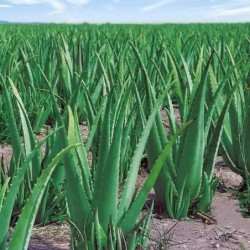
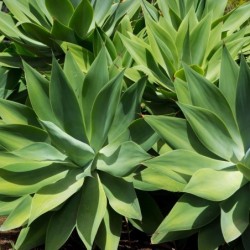
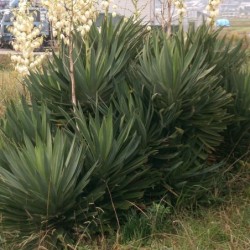
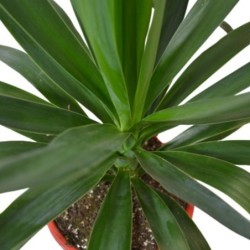
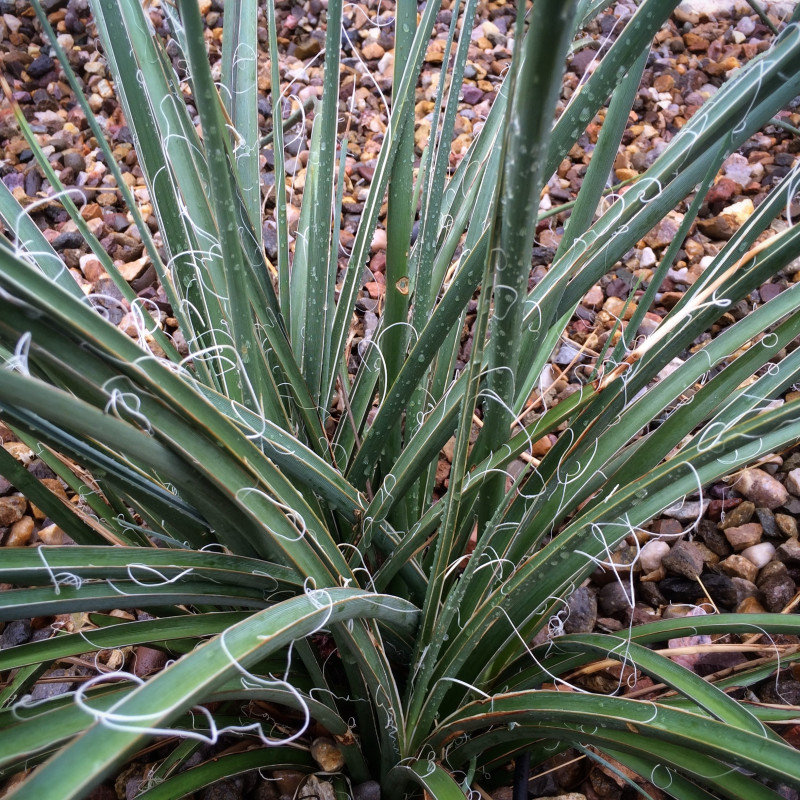
Hesperaloe parviflora, also known as red yucca, hummingbird yucca, redflower false yucca and samandoque, is a succulent plant in the Asparagaceae family (subfamily Agavoideae) that is native to the Chihuahuan and Coahuilan deserts of Northern Mexico, as well as Central, Southern and Western Texas; today, it is often seen in roadside planting swathes and public areas, or used for corporate or office exterior landscaping. It is also quite popular in collector gardens and among private gardeners who are striving for a more water-wise approach. Hesperaloe has narrow, funnel-like evergreen leaves with a slightly sharp tip, with a fringe of white, thread-like fibers along the edges—not unlike those seen on related species (such as Agave filifera or A. schidigera, for example). The species grows in clumps up to 3–6 ft (0.91–1.83 m) high by as wide. Vibrant red or yellow, tubular flowers are borne on branching, reddish-tinted inflorescences (measuring up to 1.5 m/5 ft in length) from late spring to midsummer; these blooms are often a highlight in the garden, said to resemble a natural fireworks display. The blossoms are a favorite of pollinators, especially hummingbirds. Pollinated blooms eventually develop into woody, pistachio-like seedpods, which hang off of the dried inflorescence until broken or falling off; after detaching, seedpods may lie dormant for many months until rainfall or other forms of hydration finally arrive to the desert. The Latin specific epithet parviflora means with small flowers. H. parviflora has become very popular in the world of xeriscaping, especially in its native Texas and northern Mexico. In the state of Coahuila, it can be found in the Maderas del Carme Protected Area (Área Protegida Maderas del Carmen), just south of the U.S.-Mexico border from Big Bend National Park, where it may also be found. In Texas, it can be seen as far north as Lubbock and the Dallas-Fort Worth area, and as far east as Tyler.

 Register here to access prices and place orders
 Buy now at